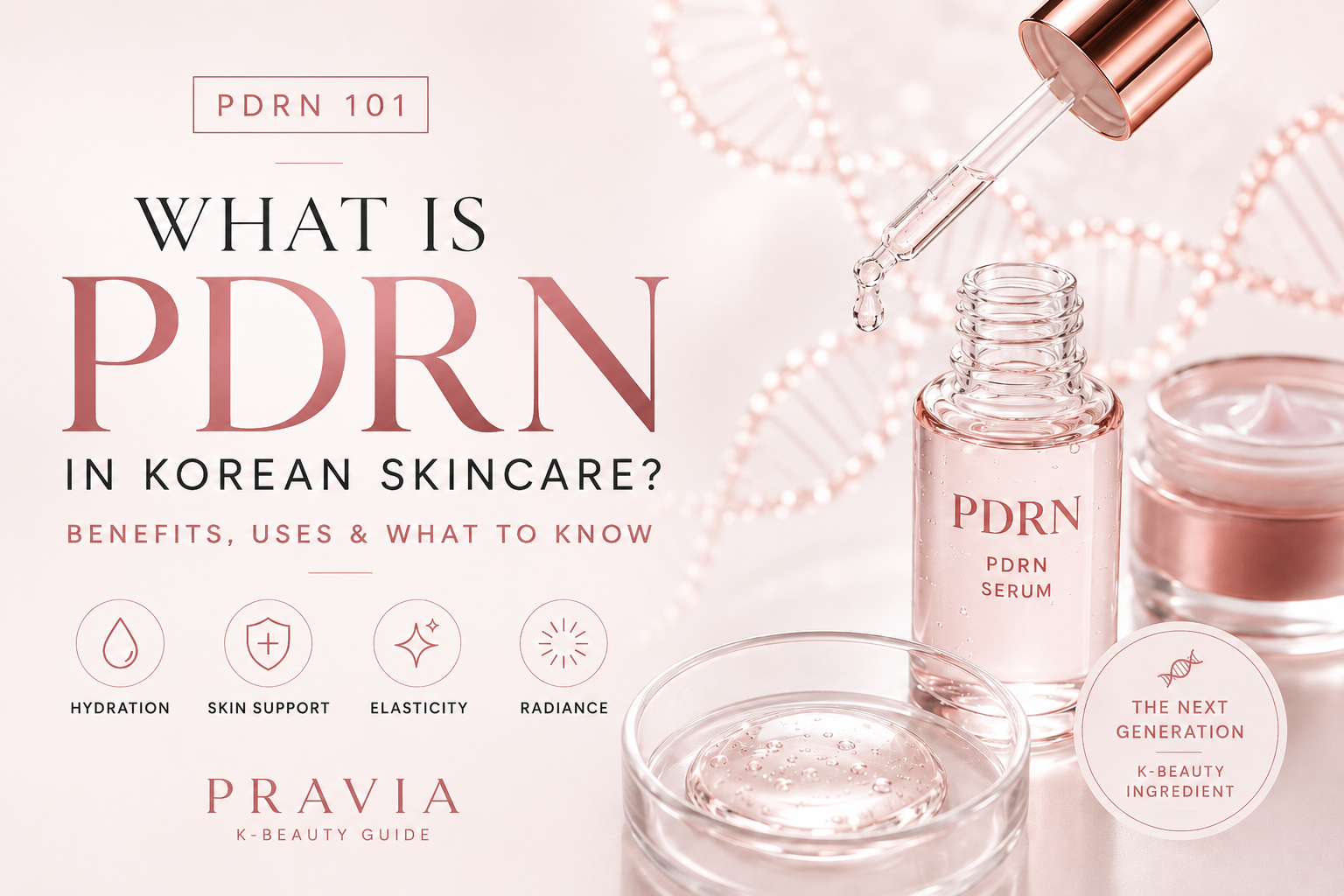
A research-based guide to topical PDRN, its potential benefits, and what skincare users should know.
PDRN stands for polydeoxyribonucleotide, a mixture of DNA-derived fragments studied in regenerative medicine and dermatology. It is increasingly used in Korean skincare products marketed for hydration, skin resilience, elasticity and the appearance of stressed or aging skin.
However, much of the strongest clinical evidence still comes from medical or aesthetic treatments rather than ordinary leave-on cosmetics. Topical PDRN research is promising, but still developing.
If you have been following Korean skincare recently, you may have noticed one ingredient appearing everywhere: PDRN.
Once better known in medical and aesthetic settings, PDRN is now appearing in Korean serums, ampoules, eye creams, masks and moisturizers. Brands often position it as a next-generation ingredient for skin recovery, hydration and visible signs of aging.
But what exactly is PDRN? Is a PDRN serum the same thing as a clinic treatment? And how much of the hype is actually supported by research?
What Is PDRN?
PDRN, or polydeoxyribonucleotide, refers to DNA-derived polymer fragments composed of deoxyribonucleotides.
Traditionally, many PDRN preparations used in medicine and aesthetics have been derived from purified DNA sources such as salmonid fish. More recently, researchers and cosmetic manufacturers have also begun exploring plant-derived and other non-animal sources.
It is important not to confuse PDRN with PN (polynucleotide). They are related DNA-based materials, but they differ in molecular characteristics and are not necessarily interchangeable.
When a skincare product says “PDRN,” check the actual ingredient list and brand explanation. The source, concentration, molecular characteristics and formulation can differ significantly between products.
Why Is PDRN So Popular in K-Beauty?
Korean beauty trends often move ingredients from dermatology and aesthetic medicine into home skincare. PDRN is a good example of that crossover.
Interest in PDRN grew partly because it has been investigated for tissue repair, wound healing and skin regeneration in medical research. As consumers became more familiar with clinic-based regenerative treatments, cosmetic brands began developing topical products inspired by the same ingredient category.
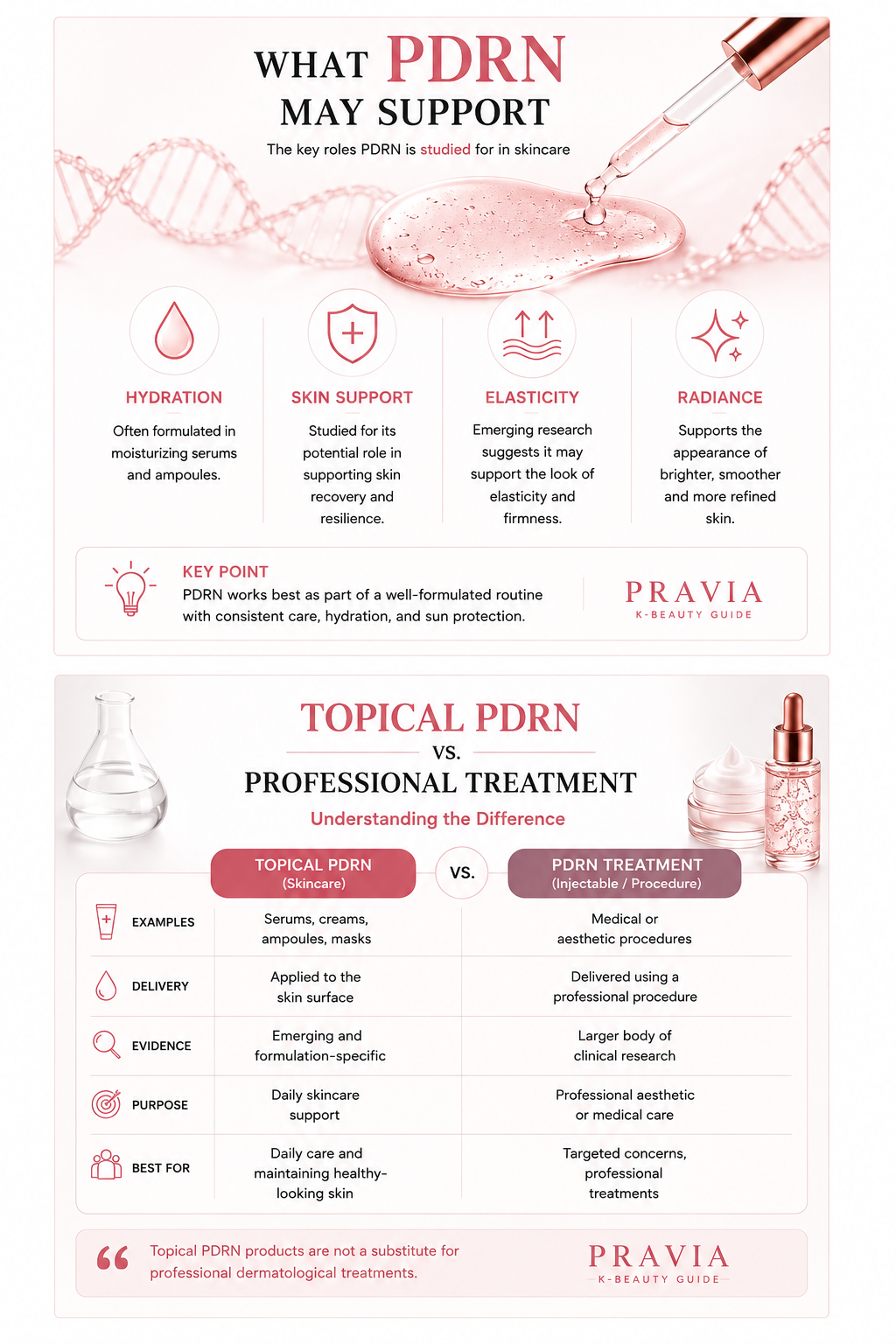
Often formulated in moisturizing serums and ampoules.
Studied for its potential role in supporting skin structure.
Emerging topical studies have examined elasticity and dermal parameters.
PDRN has a longer research history in regenerative applications.
What Are the Potential Skin Benefits of PDRN?
1. May support the appearance of healthier skin
PDRN has been studied for biological pathways associated with tissue repair and cellular recovery. This is one reason it has attracted interest in dermatology and regenerative medicine.
2. May help improve visible skin quality
Recent topical research suggests that certain PDRN formulations may affect parameters related to dermal structure and visible photoaging. That does not mean every PDRN cosmetic will produce the same result, because formulation and delivery matter.
3. Often pairs well with hydrating skincare
Many Korean PDRN products combine the ingredient with familiar moisturizers and barrier-supporting ingredients such as hyaluronic acid, glycerin, ceramides, panthenol or peptides.
In practice, much of the immediate softness or hydration a consumer feels from a PDRN product may also come from these supporting ingredients.
4. Has growing research interest for photoaged skin
A 2026 study investigated a topical medium-length PDRN preparation in photodamaged skin and reported improvements in several measured skin parameters in a short-term split-face study. It is an encouraging development, but one study should not be treated as proof that all topical PDRN products work identically.
Clinical and regenerative research on PDRN is growing, but studies vary widely in formulation, delivery method, dose and treatment setting. Evidence from injectable or medical applications cannot automatically be transferred to an over-the-counter serum or cream.
Topical PDRN vs. PDRN Treatments
| Topical Skincare | Professional Treatment | |
|---|---|---|
| Examples | Serums, creams, ampoules, masks | Medical or aesthetic procedures |
| Delivery | Applied to the skin surface | Delivered using a professional procedure |
| Evidence | Emerging and formulation-specific | Larger body of clinical research |
| Purpose | Daily cosmetic skincare | Professional aesthetic or medical care |
A topical PDRN product should not be considered a substitute for a professional dermatological treatment.
Who Might Like PDRN Skincare?
PDRN skincare may appeal to people looking for products focused on:
- Dry or dehydrated-looking skin
- Dull or tired-looking skin
- Visible loss of elasticity
- A more supportive skincare routine for mature-looking skin
- K-beauty formulas inspired by regenerative skincare trends
Sensitive skin users should evaluate the entire formula, not PDRN alone. Fragrance, exfoliating acids, retinoids, essential oils or other actives in the same product may influence tolerability.
How to Use PDRN in Your Skincare Routine
STEP 1 · Cleanse
Start with clean skin.
STEP 2 · Toner or Essence
Apply lighter hydrating layers first.
STEP 3 · PDRN Serum or Ampoule
Apply according to the product directions.
STEP 4 · Moisturizer
Seal in hydration with a moisturizer suitable for your skin type.
STEP 5 · Sunscreen in the Morning
Daily sun protection remains one of the most important steps for preventing visible photoaging.
What to Look for When Choosing a PDRN Product
Do not choose a product simply because “PDRN” appears in large letters on the packaging.
CONTINUE THE PDRN SERIES
Explore Korean PDRN products and compare PDRN with collagen.
Continue with our product guide, then learn which ingredient may better match your skincare goals.
Read: Best Korean PDRN Skincare Products to Know in 2026 →
Read: PDRN vs. Collagen Skincare—Which Is Better for Your Skin? →
PDRN is one of the most interesting ingredients in the current Korean skincare market — but we prefer to separate exciting science from marketing hype.
For everyday skincare, think of PDRN as one part of a well-formulated routine rather than a miracle ingredient. Sunscreen, moisturization, gentle cleansing and consistent use still matter more than chasing a single trend.
Frequently Asked Questions
Is PDRN the same as salmon DNA?
Not exactly. Some PDRN preparations are traditionally produced from purified DNA derived from salmonid sources, but PDRN refers to the resulting DNA-derived fragments rather than simply “salmon DNA.” New non-animal and plant-derived approaches are also being researched.
Is PDRN the same as PN?
No. PDRN and PN belong to related DNA-based material categories, but differences in polymer length, molecular weight and biological characteristics mean the terms should not automatically be used interchangeably.
Can I use a PDRN serum every day?
Follow the directions for the specific product. Frequency depends on the complete formulation rather than the word “PDRN” alone.
Can PDRN replace retinol?
They should not be treated as direct substitutes. Retinoids have a much larger body of evidence for photoaging, while topical PDRN is an emerging skincare category with a developing evidence base.
Is PDRN suitable for sensitive skin?
It may be included in formulas designed for sensitive skin, but tolerability depends on the entire product. Patch testing is sensible when trying a new cosmetic, especially if your skin is reactive.
References & Further Reading
Kim ST. Comparison of Polynucleotide and Polydeoxyribonucleotide in Dermatology: Molecular Mechanisms and Clinical Perspectives. Pharmaceutics. 2025.
Kream EJ, et al. Global Trends and Evidence Evaluation: A Systematic Review of Polynucleotide and Polydeoxyribonucleotide Therapy in Dermatology. Dermatologic Surgery. 2026.
Alhussain AM, et al. Polynucleotides and Polydeoxyribonucleotides for Skin Rejuvenation, Postoperative Scar Prevention, and Wound Healing: A Systematic Review of Randomized Clinical Trials. 2026.
Ye R, et al. Topical medium-length PDRN enhances dermal extracellular matrix repair in photodamaged skin via PI3K-Akt/TGF-β-regulated pathways. PLOS ONE. 2026.
'K-Beauty > Ingredients' 카테고리의 다른 글
| FDA Adds Bemotrizinol in 2026: What It Means for Korean Sunscreen (0) | 2026.09.05 |
|---|
