The FDA added bemotrizinol to the U.S. OTC sunscreen monograph. Here is what the decision changes—and what Korean sunscreen shoppers should not assume.
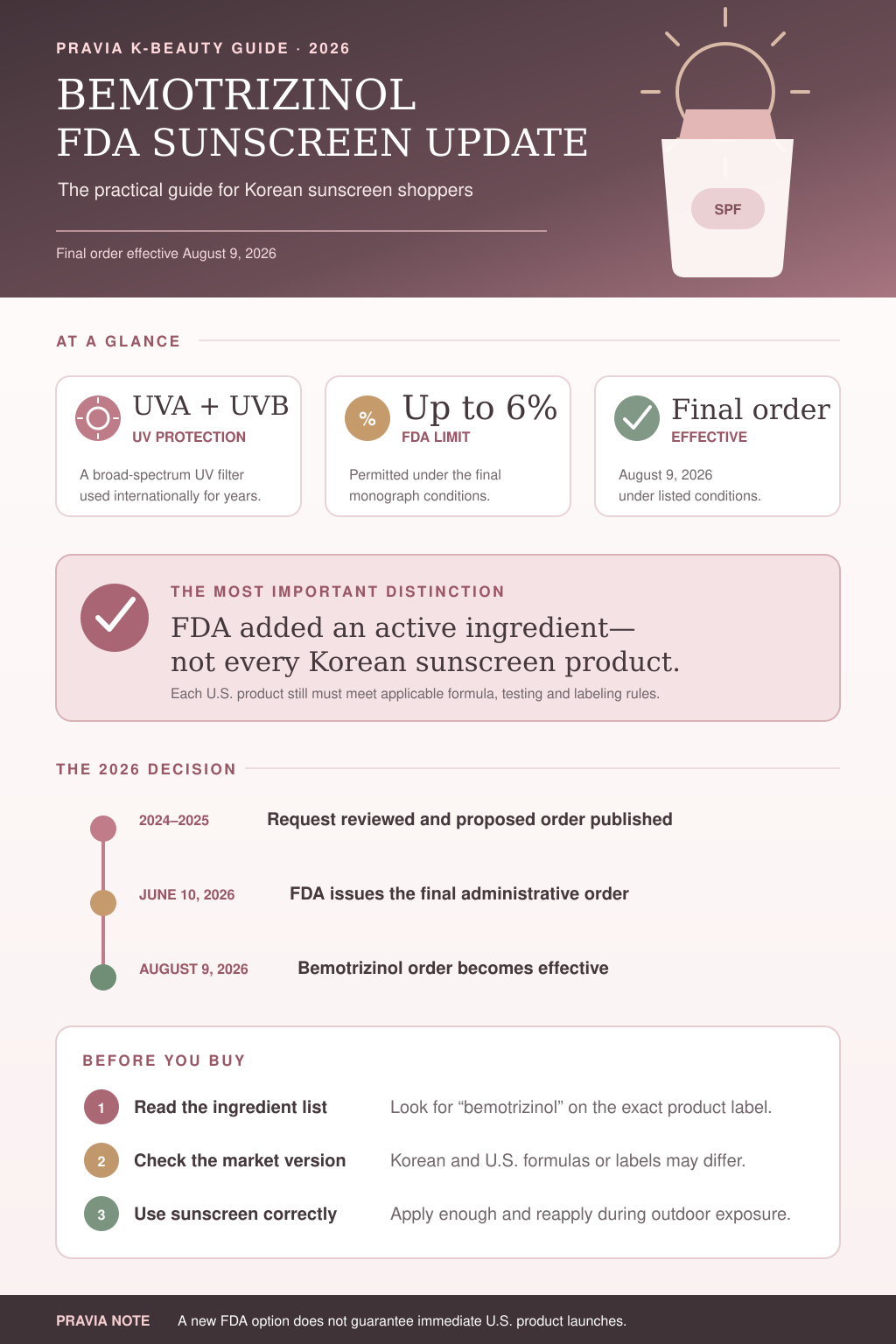
What happened? FDA Final Administrative Order OTC000039 added bemotrizinol as a permitted sunscreen active ingredient under specified conditions. The order took effect on August 9, 2026.
Why does it matter? It is the first new active ingredient added to the U.S. OTC sunscreen monograph since the late 1990s and can provide both UVA and UVB protection.
What does it not mean? It does not automatically approve every Korean or imported sunscreen, and it does not guarantee that new products will appear on U.S. shelves immediately.
For years, one of the biggest differences between U.S. sunscreen and many international sunscreen formulas has been the list of permitted ultraviolet filters. In 2026, that list changed. The U.S. Food and Drug Administration added bemotrizinol to the over-the-counter sunscreen monograph after reviewing safety and efficacy data.
The decision is genuinely important, but the social-media version can become misleading very quickly. “FDA adds a new sunscreen filter” is accurate. “The FDA has now approved Korean sunscreens” is not. This guide explains the decision in plain English, separates the legal change from the beauty headlines and shows what shoppers should check next.
Bemotrizinol may now be used in qualifying U.S. OTC sunscreen products under FDA’s conditions, but each finished product still has to satisfy applicable formulation, testing, labeling, manufacturing and marketing requirements.
What Is Bemotrizinol?
Bemotrizinol is an organic sunscreen filter that helps protect against both UVA and UVB radiation. FDA’s 2026 news release describes it as providing protection across both ranges and notes low levels of absorption through the skin into the body.
After reviewing the submitted evidence, FDA determined that bemotrizinol can be generally recognized as safe and effective—often shortened to GRASE—when it is used under the conditions established in the final order. FDA evaluated concentrations up to and including 6 percent for sunscreen products intended for adults and children six months of age and older.
The conditions are more specific than “up to 6%”
The final order addresses concentration, permitted combinations with other sunscreen and skin-protectant active ingredients, dosage forms and finished-product testing. It allows qualifying products in forms including oil, lotion, cream, gel, butter, paste, ointment, stick and certain sprays. The order does not support powder sunscreen or propellant-mixed aerosol formulas containing bemotrizinol under these conditions.
That detail matters to K-beauty shoppers because a familiar ingredient name alone does not determine whether an imported or reformulated product conforms to the U.S. monograph.
The FDA Bemotrizinol Timeline
| Date | Action | Why It Matters |
|---|---|---|
| September 23, 2024 | DSM submitted an OTC monograph order request. | The request sought to add bemotrizinol at concentrations up to 6%. |
| December 12, 2025 | FDA issued the proposed administrative order. | A public-comment period followed before the decision was finalized. |
| June 10, 2026 | FDA issued Final Administrative Order OTC000039. | Bemotrizinol was added to OTC Monograph M020 under specified conditions. |
| August 9, 2026 | The final order took effect. | Qualifying U.S. OTC sunscreen products could use the new monograph pathway. |
| August 10, 2026 | FDA published a corrected final-order document. | FDA states that the corrections addressed minor typographical errors. |
What the Decision Means for Korean Sunscreen
One internationally used filter now has a U.S. pathway
FDA notes that bemotrizinol has been marketed as a sunscreen ingredient in Europe and many other countries for years. Its addition creates a route for qualifying U.S. products to use the filter without a separate approved drug application, provided they conform to the monograph and other applicable requirements.
Brands may gain another tool for broad-spectrum formulas
Because bemotrizinol protects across UVA and UVB wavelengths and may be combined with certain other permitted filters, the decision expands the formulation options available within the U.S. OTC framework. It does not guarantee a specific texture, zero white cast, better makeup wear or superior performance for every formula.
A global product name may still hide different formulas
Korean beauty brands sometimes create market-specific versions to meet local rules. A product sold in Seoul, Paris and New York may share branding while using different active ingredients, claims or labels. Check the exact package for the destination market instead of relying only on a review of another regional version.
The ingredient list matters—but so does the market label
American OTC sunscreens identify active ingredients in a Drug Facts panel. Products purchased outside the United States may be labeled under a different regulatory system. FDA specifically advises shoppers purchasing sunscreen outside the U.S. to read the label and understand possible differences.
Review the exact product page, ingredient list and package for your destination. Availability, price, shipping and regional labeling can change.
VISIT PRAVIA BEAUTY ON JOOM →Five Claims to Read Carefully
| Headline or Claim | Verdict | What Is More Accurate |
|---|---|---|
| “FDA approved bemotrizinol.” | Needs context | FDA added it to the OTC sunscreen monograph under specified conditions. |
| “All Korean sunscreens are now FDA-approved.” | False | The action concerns an ingredient pathway, not blanket product approval. |
| “Every international bemotrizinol formula can be sold unchanged in the U.S.” | False | A finished product must meet applicable U.S. conditions and requirements. |
| “New bemotrizinol sunscreens should already be everywhere.” | Not guaranteed | Manufacturers determine launch timing, and compliant product development takes time. |
| “A newer filter means I can apply less.” | False | Coverage still depends on sufficient, even application and timely reapplication. |
The filter matters. The finished sunscreen matters more.
FDA cited adequate evidence from two independent human clinical efficacy studies and reviewed clinical and nonclinical safety information for bemotrizinol under the order’s conditions. That supports the ingredient decision; it does not make all products containing the ingredient identical.
Real-world performance also depends on the full filter system, concentration, film formation, stability, application amount, water resistance, coverage and reapplication. Texture matters because a sunscreen you dislike wearing is harder to use consistently.
How to Read a Korean Sunscreen Label in 2026
The American Academy of Dermatology recommends a broad-spectrum, water-resistant sunscreen with SPF 30 or higher. No filter announcement replaces shade, protective clothing, a wide-brimmed hat or adequate application.
Frequently Asked Questions
Did the FDA approve bemotrizinol in 2026?
More precisely, FDA issued a final administrative order adding bemotrizinol to the OTC sunscreen monograph under specified conditions. The order took effect on August 9, 2026.
Is bemotrizinol the first new U.S. sunscreen filter in decades?
Yes. FDA describes it as the first new active ingredient added to the U.S. OTC sunscreen monograph since the late 1990s.
Does bemotrizinol protect against UVA and UVB?
FDA states that bemotrizinol provides protection against both UVA and UVB radiation. Finished-product broad-spectrum and SPF claims still depend on required product testing and labeling.
Can every Korean sunscreen containing bemotrizinol now be sold in the U.S.?
No. The finished sunscreen must meet applicable U.S. requirements, including the conditions in the monograph. An ingredient’s permitted status is not blanket approval of every international formula.
Can bemotrizinol be used in U.S. sun sticks?
Yes, stick is among the dosage forms permitted by the final order when the finished product satisfies the applicable conditions. Powder dosage forms were not supported in this order.
Do I still need to reapply a bemotrizinol sunscreen?
Yes. A newer active ingredient does not remove the need for correct application. Follow the label and reapply at least every two hours, more often after swimming or sweating.
References & Official Sources
- U.S. Food and Drug Administration, “FDA Expands Sunscreen Options for the First Time in 20 Years.” June 9, 2026.
- FDA OTC Monographs, Final Order OTC000039 detail page. Final order issued June 10, 2026; corrected August 10, 2026.
- FDA Final Administrative Order OTC000039. Effective August 9, 2026.
- U.S. Food and Drug Administration, “Sunscreen: How to Help Protect Your Skin from the Sun.” Updated 2026.
- American Academy of Dermatology, “Sunscreen FAQs.” Accessed September 4, 2026.
'K-Beauty > Ingredients' 카테고리의 다른 글
| What Is PDRN in Korean Skincare? Benefits, Uses & What to Know (0) | 2026.08.28 |
|---|
