PDRN vs. Collagen Skincare
One is a treatment-inspired DNA-derived ingredient. The other is a familiar moisturizing protein. Here is what each can—and cannot—realistically do for your skin.
PDRN is the more experimental, treatment-inspired choice. Defined topical PDRN formulas have emerging evidence related to photodamaged skin, but results cannot be generalized to every PDRN product.
Topical collagen is the more straightforward hydration choice. It can help skin feel smoother and look temporarily plumper by supporting surface hydration, but it should not be treated as a replacement for the collagen already inside your skin.
PDRN and collagen are frequently placed next to each other in Korean skincare: in pink serums, capsule creams, hydrogel masks and products promising a firmer-looking glow. Some formulas even combine both ingredients. That packaging can make them seem interchangeable, but biologically and cosmetically they are very different materials.
PDRN refers to DNA-derived polymer fragments. Collagen is a structural protein. PDRN marketing tends to emphasize recovery and skin quality, while collagen skincare usually focuses on moisture, softness and visible plumpness. The better choice therefore depends on what you expect the product to do—and how much evidence you require before buying it.
The Essential Difference: Signal vs. Surface Support
A simplified way to understand the comparison is that PDRN is being studied for how a defined material may interact with biological repair-related pathways, while collagen in an ordinary topical cosmetic mainly helps at or near the skin surface.
That does not make one automatically superior. A sophisticated-sounding mechanism is not useful if the finished PDRN formula is poorly disclosed or unsuitable for your skin. Meanwhile, a collagen cream can be useful simply because it moisturizes well—even if it does not rebuild the dermal collagen network.
What Is PDRN Skincare?
PDRN stands for polydeoxyribonucleotide, a mixture of DNA-derived polymer fragments. Many traditional preparations are produced from highly purified salmonid DNA, although newer non-animal sources and differently named DNA-derived cosmetic materials are also entering the market.
Most of the established clinical history around PDRN comes from medical or professional applications, not ordinary leave-on cosmetics. Topical PDRN research is developing, but the ingredient presents a delivery challenge because nucleic acid polymers can be large. Molecular characteristics, purity, concentration and the vehicle all matter.
What does the 2026 topical study show?
A peer-reviewed 2026 PLOS ONE study investigated one specific medium-length salmon-derived material, PDRN-850K. It included laboratory work, reconstructed and ex vivo skin models, penetration analysis and a 28-day randomized split-face study of a 0.1% PDRN-850K eye cream compared with a 0.1% retinol formula.
The researchers reported changes in signaling associated with extracellular matrix activity and improvements in measured periocular parameters. This is notable because it directly examined a defined topical PDRN material rather than assuming that injectable evidence transfers to cosmetics.
But the correct conclusion is narrow: this study supports the potential of that material and formula under those study conditions. It does not prove that every serum, toner pad, mist or cream carrying the word PDRN will behave the same way. The study authors also noted that longer-term work is needed to separate early hydration or plumping effects from durable dermal remodeling.
For a deeper explanation of the ingredient and terminology, read What Is PDRN in Korean Skincare?
What Is Collagen Skincare?
Collagen is the main structural protein of the skin's extracellular matrix. In cosmetics, labels may list collagen extract, soluble collagen, hydrolyzed collagen, collagen amino acids or branded collagen complexes. These are not necessarily identical in size, source or function.
The intuitive marketing story says that applying collagen replaces collagen lost with age. The skin does not work that simply. Intact collagen is a large molecule, and ordinary topical application should not be equated with inserting new structural collagen into the dermis.
A 2025 review of collagen-based products concluded that topical collagen can improve skin hydration but is unlikely to replace endogenous collagen. That distinction does not make collagen skincare useless. Film-forming and moisture-supporting ingredients can reduce the appearance of dehydration lines, improve softness and create an immediately smoother finish.
What collagen skincare is realistically good at
- Helping dry skin feel softer and more comfortable
- Supporting temporary visible plumpness through hydration
- Creating a smooth, flexible film in masks and creams
- Improving the sensory experience of a moisturizing routine
The immediate glow from a collagen hydrogel mask may be real, but it is more responsibly described as hydration and temporary plumping—not newly built dermal collagen.
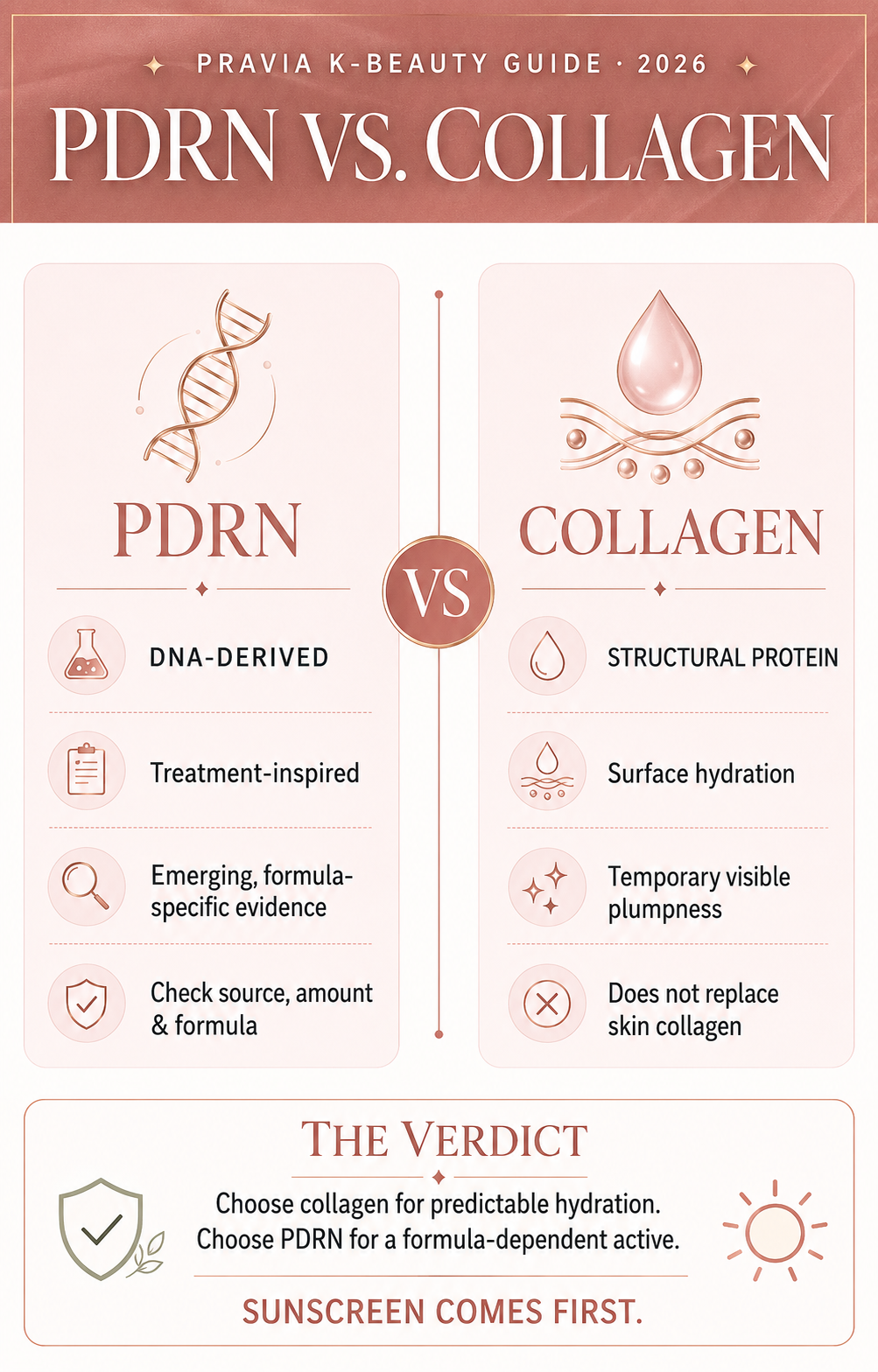
PDRN vs. Collagen Skincare: Side-by-Side
| Question | PDRN Skincare | Collagen Skincare |
|---|---|---|
| What is it? | DNA-derived polymer fragments | A structural protein or collagen-derived material |
| Most realistic topical role | Formula-specific treatment-inspired skin support | Surface hydration, film formation and temporary plumpness |
| Evidence | Emerging and highly material/formula-specific | Useful for hydration; not evidence of replacing dermal collagen |
| When results may be noticed | Hydration may be quick; targeted changes require consistent use and product-specific proof | Softness and plumpness can be immediate but temporary |
| Best format | Well-disclosed serum, essence or cream | Moisturizing cream, serum or hydrogel mask |
| Main watch-out | Comparing non-equivalent ppm, complexes and sources | Mistaking temporary hydration for collagen replacement |
| Animal-source concern | Often salmon-derived; verify disclosure | Often marine or bovine; verify disclosure |
Which Is Better for Your Skin?
Browse the PRAVIA Beauty store on Joom. Product selection, pricing and delivery availability vary by destination country.
VISIT PRAVIA BEAUTY ON JOOM →Can You Use PDRN and Collagen Together?
Yes. There is no general reason these ingredient categories must be separated in an ordinary cosmetic routine. Korean products increasingly combine them, often placing PDRN inside a hydrating collagen serum, capsule cream or hydrogel mask.
Combining the words does not automatically create a stronger treatment. The benefit still depends on the complete formula. In many hybrid products, collagen and humectants provide the immediate moisture and slip, while PDRN supplies the treatment-inspired positioning.
Simple routine option
- Cleanser: use a gentle cleanser suited to your skin type.
- Hydrating toner or essence: optional, especially for dry skin.
- PDRN or PDRN-collagen serum: apply according to the product directions.
- Collagen or barrier moisturizer: seal in hydration if needed.
- Sunscreen: use broad-spectrum SPF 30 or higher in the morning.
You do not need a separate PDRN serum, collagen serum, collagen mask and collagen cream in the same routine. Repetition increases cost and product load without guaranteeing better results.
Neither ingredient replaces the fundamentals
The American Academy of Dermatology identifies daily sun protection as the foundation of an anti-aging skincare plan and notes that moisturizer helps trap water in the skin. A trending serum cannot compensate for repeated UV exposure or an uncomfortable, inconsistent routine.
Use PDRN or collagen as an optional targeted step—not as permission to skip sunscreen, gentle cleansing and adequate moisturization.
How to Shop Without Falling for the Hype
Hero ingredients do not tell you whether the product is fragranced, rich, exfoliating or suitable for your skin.
A ppm figure may refer to pure Sodium DNA, a raw-material solution or a branded complex. Numbers with different bases are not directly comparable.
A study of ingested collagen peptides does not prove that a collagen cream produces the same effect.
An elegant serum for oily skin and a rich capsule cream for dry skin can both be good products; they simply serve different users.
Retail listings, ingredient lists and delivery regions can change. Confirm the latest product page before purchasing.
To compare seven currently discussed Korean PDRN formulas by source, declared amount, supporting ingredients and watch-outs, see Best Korean PDRN Skincare Products to Know in 2026.
Frequently Asked Questions
Is PDRN better than collagen for anti-aging?
Not universally. PDRN has emerging formula-specific research related to photodamaged skin, while topical collagen is more realistically used for hydration and temporary plumpness. Daily sun protection and a well-tolerated routine remain more important than either trend ingredient alone.
Does collagen cream rebuild collagen in the skin?
Topical collagen can support hydration and film formation, but it should not be described as directly replacing the structural collagen inside the dermis.
Can I use PDRN and collagen every day?
Follow the directions for the specific product. Many moisturizing formulas are designed for daily use, but frequency depends on the entire ingredient list and your skin's response.
Can PDRN replace retinol?
They should not be treated as direct substitutes. Retinoids have a much larger evidence base across dermatology. One short study of a defined PDRN eye cream does not establish class-wide equivalence to retinoids.
Is PDRN the same as salmon collagen?
No. Some PDRN is derived from purified salmonid DNA, while marine collagen is a protein-derived material. Sharing a marine source does not make the ingredients chemically or functionally equivalent.
Which is better for dry skin?
Collagen skincare may provide a more immediately noticeable moisturizing feel, but the full base formula matters most. Look for humectants, emollients and barrier-supporting ingredients suited to your skin.
What Is PDRN in Korean Skincare? →
References & Further Reading
- Ye R, Wang Q, Du L, Li L, Hu F. Topical medium-length PDRN enhances dermal extracellular matrix repair in photodamaged skin via PI3K–Akt/TGF-β–regulated pathways. PLOS ONE. 2026;21(7):e0350905.
- Kream EJ, et al. Global Trends and Evidence Evaluation: A Systematic Review of Polynucleotide and Polydeoxyribonucleotide Therapy in Dermatology. Dermatologic Surgery. 2026.
- Sen CK, Friday A, Khanna S, Roy S. Collagen-Based Products in Wound, Skin, and Health Care. Advances in Wound Care. 2025. PMID: 40720447.
- American Academy of Dermatology. Skin care in your 40s and 50s. Accessed September 2, 2026.