5 K-Beauty Trends Shaping 2026
PDRN, Korean haircare, hydrogel masks, K-pharmacy formulas and bloom skin are changing what shoppers look for—and how we should judge the claims.
The biggest K-beauty shift in 2026 is not one miracle ingredient. It is the move toward treatment-inspired formulas, scalp-first haircare, high-contact mask formats, barrier-focused clinical positioning and a softer glow known as bloom skin. The smartest approach is to shop by your skin or scalp need—not by the loudest trend name.
K-beauty is no longer a niche category watched only by dedicated beauty shoppers. In August 2026, Sephora introduced an Olive Young-curated K-beauty assortment in the United States, another sign that Korean beauty discovery is moving into mainstream global retail. At the same time, the trends themselves are changing: shoppers are asking for visible results, but they are also paying closer attention to barrier comfort, routine simplicity and whether a formula fits real life.
That combination explains why some of this year's fastest-moving ideas look surprisingly practical. Scalp serums are replacing complicated hair rituals. Hydrogel masks promise a concentrated at-home moment. Clinical-looking K-pharmacy products make barrier care feel approachable. And bloom skin softens the ultra-reflective glass-skin look into something more wearable.
This guide separates the useful direction behind each trend from the marketing shorthand surrounding it.
Treatment-inspired topical actives
Scalp-first Korean haircare
Long-wear mask formats
Barrier-first clinical positioning
A softer, skin-first glow
Why 2026 Feels Different
Several signals are converging. Cosmetics Business, citing NielsenIQ, reported that K-beauty grew 53% globally in the year ending January 2026 and 131% over two years. The same industry report identified Korean haircare, collagen masks, K-pharmacy and bloom skin among the year's leading movements. These numbers describe market momentum, not proof that every trending product performs better—but they do show where consumer attention is moving.
The more important change is qualitative. Vogue's 2026 trend reporting highlights “slow aging,” a more resilient version of glass skin and greater interest in scalp care and glass hair. In other words, the conversation is expanding from instant shine to long-term condition: healthy-looking skin, a comfortable barrier and hair that begins with a cared-for scalp.
PDRN Becomes Part of a Bigger “Treatment-Inspired” Category
PDRN remains one of the most recognizable Korean skincare ingredients in 2026, but it is now appearing beside peptides, spicules, exosome-positioned ingredients and other formulas inspired by professional treatments. The appeal is easy to understand: shoppers want a topical routine that feels more targeted than a basic hydrating serum.
The important detail is that PDRN is not one standardized consumer formula. Products may differ in source, molecular characteristics, concentration, supporting ingredients and delivery system. A large number on the front of a box can refer to pure Sodium DNA, a raw-material blend or a proprietary complex. Those figures should not be compared as if they were automatically equivalent.
- The named PDRN or DNA ingredient and its source, when disclosed
- Whether the stated amount refers to the active itself or a complex
- Supporting ingredients such as glycerin, panthenol, ceramides or peptides
- Fragrance, essential oils and texture if your skin is reactive
A 2026 PLOS ONE study reported results for one specific medium-length PDRN material and a 0.1% eye-cream formula over 28 days. That is useful emerging evidence, but it does not validate every product labeled PDRN. Formula-specific studies should remain formula-specific.
New to the ingredient? Start with our evidence-focused guide, What Is PDRN in Korean Skincare? Then compare current options in Best Korean PDRN Skincare Products to Know in 2026.
Korean Haircare Becomes Scalp-First
The next global K-beauty category may not be skincare at all. Korean haircare is gaining attention through scalp essences, water scalers, lightweight serums, no-rinse treatments and high-shine “glass hair” finishes. Cosmetics Business reported that K-beauty hair-serum sales in the UK grew 80% year over year, compared with 18% for total haircare.
The Korean approach often treats the scalp as the starting point of the routine. Instead of relying only on a heavy mask to make damaged lengths look smoother, shoppers are being introduced to targeted steps for oil, buildup, dryness and comfort at the roots—followed by lighter conditioning and repair products through the lengths.
Choose by scalp condition, not by the trend name. An oily scalp may prefer a thorough but non-stripping cleanse and a lightweight tonic. A dry or easily irritated scalp needs a gentler formula and fewer exfoliating steps. Bleached or heat-damaged hair may benefit more from conditioning and bond-supporting care than from adding another scalp active.
Hydrogel Collagen Masks Move Beyond a Novelty
Hydrogel masks are evolving from a once-in-a-while novelty into a recognizable K-beauty format. The most visible versions are worn for several hours or overnight and become thinner or more transparent as they sit on the skin. Newer formulas combine the format with collagen, PDRN, peptides, ceramides or soothing ingredients.
The format can be useful because it keeps a hydrating formula in close contact with the skin and creates an occlusive environment that reduces immediate water loss. That can make skin look temporarily plumper and more reflective—especially before an event or after travel.
However, the visual “melting” effect is not evidence that collagen has traveled deep into the dermis. A 2025 review indexed in PubMed concluded that topical collagen can improve hydration but is unlikely to replace the skin's own collagen. Treat the mask as a hydration and sensory product unless the finished formula has stronger product-specific evidence.
K-Pharmacy Makes Barrier Care the Main Event
“K-pharmacy” is the retail shorthand for Korean beauty products with a clinical, dermatology-inspired or pharmacy-adjacent identity. Expect restrained packaging, straightforward claims and formulas centered on ceramides, panthenol, cica, ectoin, squalane, urea or similar barrier-supporting ingredients.
This trend overlaps with a wider reset in skincare. After years of layering acids, retinoids and brightening actives, many shoppers want a dependable moisturizer or recovery cream that makes an ambitious routine easier to tolerate. The enduring part of K-pharmacy is therefore not the white packaging; it is the return to barrier function and skin comfort.
The label still needs careful reading. A pharmacy aesthetic does not automatically make a cosmetic a medicine, and regulatory classification varies by product and market. Look for the actual ingredient list, usage directions and claims permitted where you live. If you have eczema, dermatitis, a suspected infection or a persistent reaction, a cosmetic trend is not a substitute for medical care.
Bloom Skin Replaces Surface Shine
Glass skin is not disappearing, but its 2026 update is softer. Bloom skin describes a naturally luminous finish that appears to come from hydrated, comfortable skin rather than from a glossy layer sitting on top. Think diffused radiance, even texture and flexible hydration—not a mirror-like finish at any cost.
The idea fits the move toward streamlined routines. A bloom-skin routine does not require ten steps:
- Cleanse gently without leaving the skin tight.
- Add one hydrating layer with humectants such as glycerin or hyaluronic acid.
- Seal with a barrier-friendly moisturizer suited to your skin type.
- Use broad-spectrum sunscreen every morning.
- Add a targeted active only when it addresses a real concern.
Makeup can support the finish with thin layers and strategically placed radiance, but the trend's lasting lesson is more useful: do not confuse irritation, oiliness or product overload with a healthy glow.
Trend evidence and product evidence are not the same thing
Sales growth, search interest and retailer expansion tell us that a category is popular. Ingredient studies tell us that a material may have biological potential under specific conditions. Neither one automatically proves that every finished cosmetic with the trend word on its label will produce the same result.
For PDRN, collagen masks and emerging delivery technologies, ask one extra question: What evidence exists for this finished formula, concentration and method of use?
How to Shop the 2026 Trends Intelligently
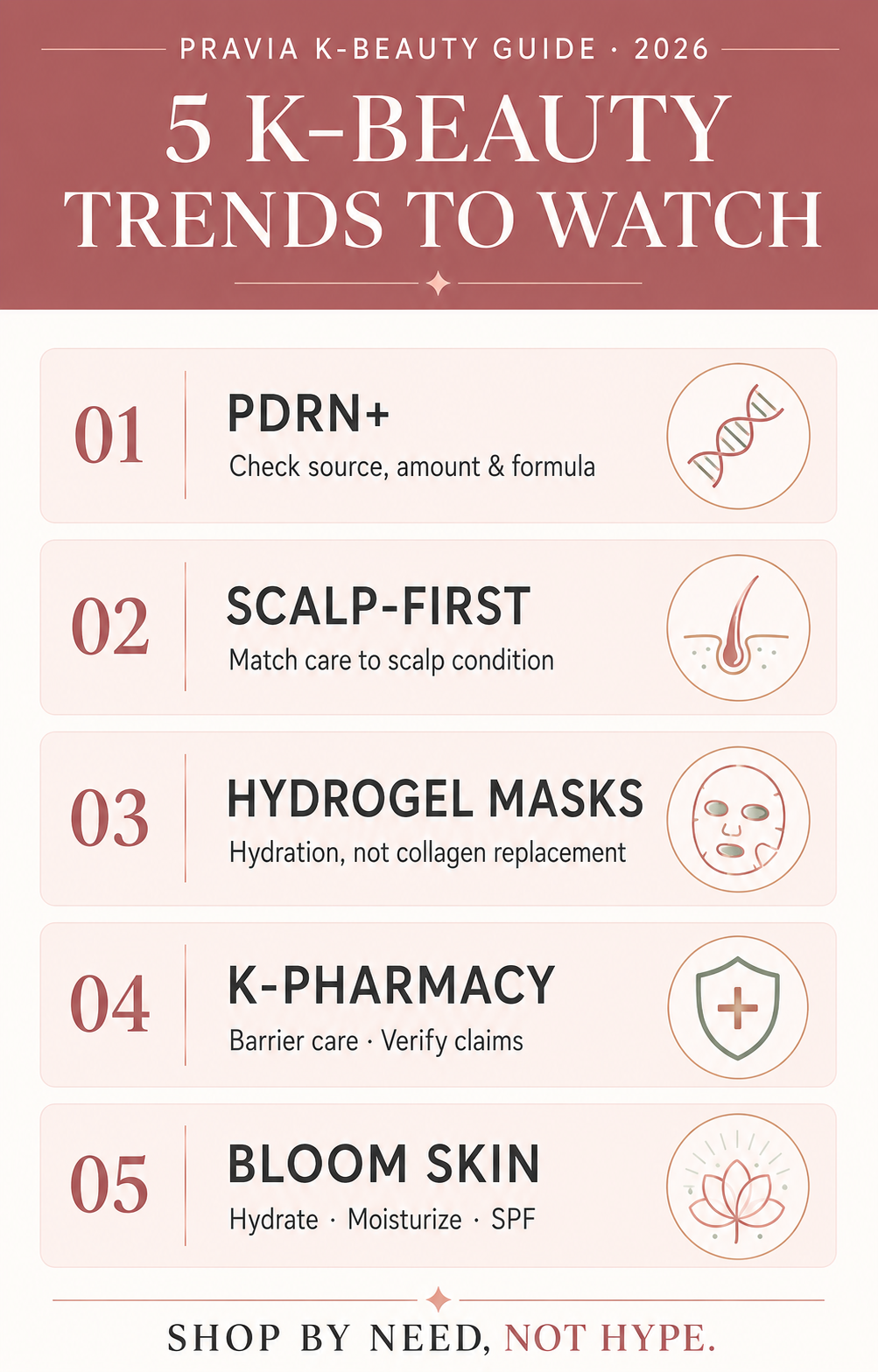
| Trend | What You Will See | Smart Way to Try It | Watch-Out |
|---|---|---|---|
| PDRN+ | Serums, creams and sprays | Compare source, amount basis and full INCI | A headline ingredient is not universal evidence |
| K-haircare | Scalp serums, scalers and no-rinse treatments | Choose for your scalp and damage level | Do not over-exfoliate the scalp |
| Hydrogel masks | Overnight and “melting” formats | Use occasionally for hydration | Instant plumpness is not collagen rebuilding |
| K-pharmacy | Clinical-looking barrier formulas | Verify ingredients and product classification | Pharmacy positioning is not medical proof |
| Bloom skin | Softer glow and fewer layers | Hydrate, moisturize and use SPF | Do not chase shine with product overload |
What Will Probably Last Beyond 2026?
Trend names will change, but three behaviors are likely to remain:
- Ingredient literacy: shoppers will keep asking what a percentage or ppm figure actually refers to.
- Barrier and scalp health: comfort, tolerance and routine consistency are more durable than a single viral ingredient.
- Selective routines: the best routine may contain one treatment step and several dependable basics, not every trending product at once.
The safest way to participate in a trend is to identify the practical benefit underneath it. If you need hydration, a well-formulated hydrating serum or mask matters more than whether the finish is called glass, glow or bloom. If you want to explore PDRN, a transparent label and suitable supporting formula matter more than the biggest number on the package. If your scalp is uncomfortable, gentleness and diagnosis matter more than achieving “glass hair.”
Frequently Asked Questions
What is the biggest K-beauty trend in 2026?
There is no single winner, but treatment-inspired skincare and scalp-first Korean haircare are two of the most important category shifts. PDRN remains highly visible, while bloom skin summarizes the move toward a softer, healthier-looking finish.
Is bloom skin the same as glass skin?
They overlap, but bloom skin is generally softer and less reflective. It emphasizes hydrated, comfortable skin and diffused radiance rather than a highly glossy surface.
What is K-pharmacy skincare?
It is an informal retail term for Korean skincare with clinical, dermatology-inspired or pharmacy-adjacent positioning. The phrase is not a universal regulatory category, so check each product's classification and claims in your market.
Is topical PDRN proven to work?
There is emerging laboratory and product-specific clinical research, including a 2026 study on one medium-length PDRN formula. Evidence should not be generalized to every PDRN serum because source, concentration, molecular characteristics and delivery system can differ.
What does Korean haircare focus on?
Current Korean haircare often starts with scalp cleansing and targeted scalp care, then uses lightweight treatments for smoothness, damage and shine through the lengths. The right routine depends on scalp condition and hair damage.
Do I need a 10-step routine to follow K-beauty trends?
No. A gentle cleanser, moisturizer and daily sunscreen form a practical base. Add one hydrating or treatment product only when it serves a specific need and your skin tolerates it.
What Is PDRN in Korean Skincare? Benefits, Uses & What to Know →
Best Korean PDRN Skincare Products to Know in 2026 →
Olive Young Is Now at Sephora: 19 K-Beauty Brands to Know in 2026 →
Best Korean Barrier Repair Products for Dry and Sensitive Skin in 2026 →
References & Further Reading
- Cosmetics Business, “The top 5 K-beauty trends of 2026 revealed.” Published August 4, 2026.
- Vogue, “The Biggest K-Beauty Trends of 2026.” Published January 16, 2026.
- Mintel, 2026 Global Beauty and Personal Care Trends.
- PLOS ONE, “Topical medium-length PDRN enhances dermal extracellular matrix repair in photodamaged skin.” Published July 10, 2026.
- PubMed, “The effect of topical collagen on skin hydration and elasticity: a systematic review.”
- Sephora Newsroom, Olive Young-curated K-beauty launch in the U.S. Published 2026.
'K-Beauty > K-Beauty Guides' 카테고리의 다른 글
| Olive Young Is Now at Sephora: 19 K-Beauty Brands to Know in 2026 (0) | 2026.09.01 |
|---|
