What PA++++ really tells you, which modern UV filters appear on Korean labels, and how five current sunscreens compare by formula profile and use case.
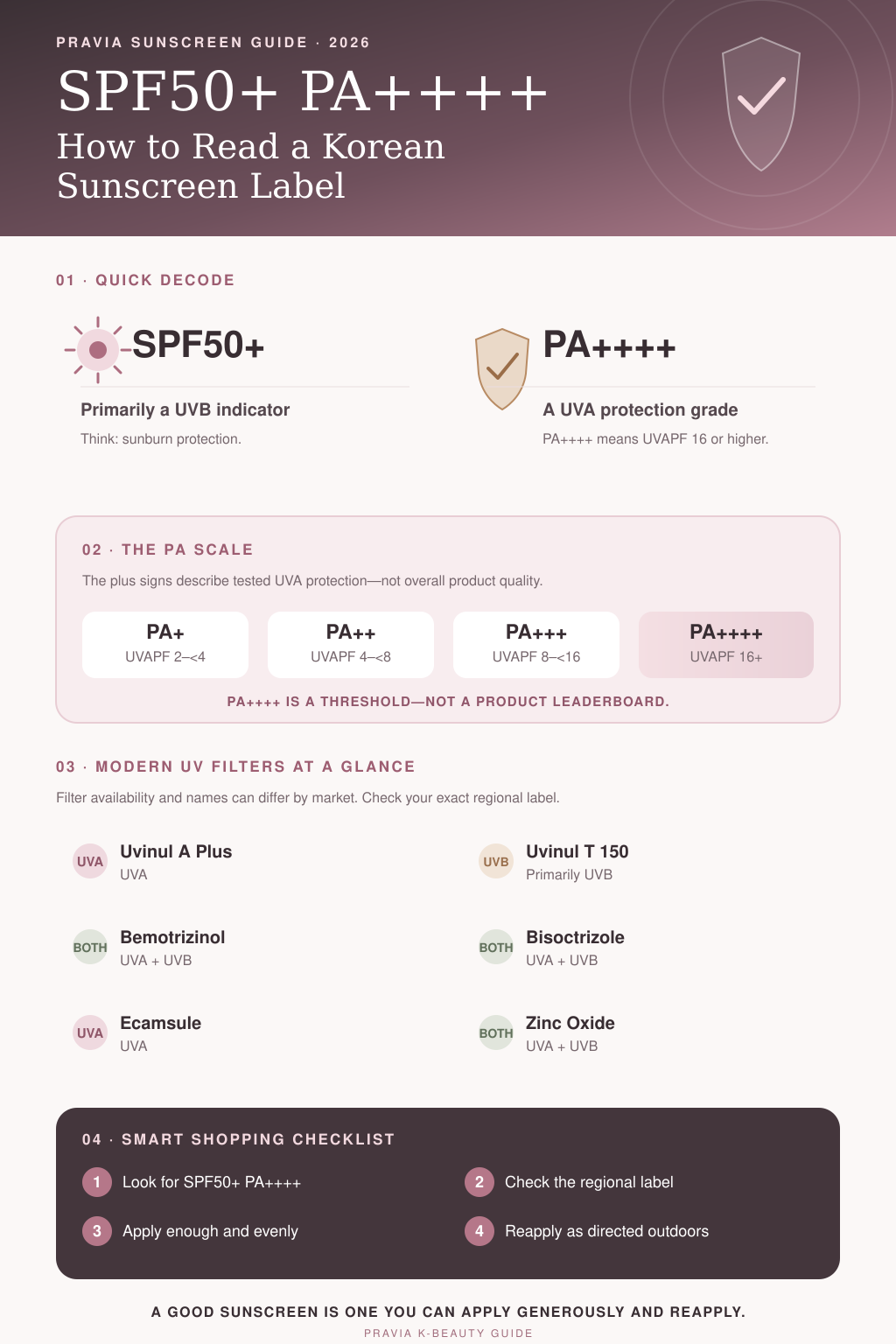
PA++++ is the highest category on the four-grade PA scale. It indicates a tested UVA protection factor, or UVAPF, of at least 16. It does not reveal the exact UVAPF above that threshold.
The practical choice is not simply the longest ingredient list. Look for SPF50+ PA++++, a formula you can apply generously, appropriate water resistance for the activity, and a texture you will willingly reapply.
Korean sunscreen labels often place SPF50+ PA++++ side by side, but the two ratings are not interchangeable. SPF primarily communicates protection against sunburn-producing UV exposure, while PA converts a measured UVA protection factor into a simple plus-sign grade.
That distinction matters because a sunscreen can feel elegant, include fashionable skincare ingredients and still need to be judged first as sunscreen. This guide explains the label before comparing five Korean products currently listed by PRAVIA Beauty on Joom. The products are organized by use case rather than ranked from No. 1 to No. 5 because PA++++ alone cannot prove that one formula has higher UVA protection than another.
SPF and PA Answer Different Questions
The SPF test measures protection against erythema, or sunburn. Because sunburn is driven mainly by UVB, SPF is primarily read as a UVB-protection indicator.
The PA system groups an in-vivo UVA protection factor into four consumer-friendly grades. More plus signs indicate a higher UVAPF band.
UVA and UVB are both relevant, but their effects and the labels used to communicate protection differ. UVA is strongly associated with persistent pigmentation and photoaging and can pass through ordinary window glass. UVB is the principal driver of sunburn. A well-rounded daily sunscreen therefore needs meaningful protection across the spectrum, not simply a high SPF number.
ISO 24442:2022 specifies an in-vivo method for determining a sunscreen product’s UVA protection factor. ISO 24444:2019 covers the in-vivo SPF method based on protection against UV-induced erythema. The ratings come from different measurements, which is why SPF50+ and PA++++ should be read together.
What Does PA++++ Mean?
| PA grade | UVAPF range | What the grade tells you |
|---|---|---|
| PA+ | 2 to under 4 | The first UVA-protection band |
| PA++ | 4 to under 8 | A higher UVA-protection band |
| PA+++ | 8 to under 16 | High UVA-protection category |
| PA++++ | 16 or higher | Top category on the four-grade scale |
The most important limitation is hidden inside the final row: PA++++ has a floor but no extra plus signs for higher results. One PA++++ product may sit near UVAPF 16 while another may test considerably higher, yet both display the same grade. Unless a brand publishes comparable test data, the label does not support a precise UVA ranking between them.
We use “best” here to mean the most useful match for a specific routine or preference among the products reviewed—not proof that one bottle has the highest laboratory-measured UVA protection.
Modern UV Filter Names on Korean Labels
Korean-market ingredient lists often use INCI names instead of the trade names popular in sunscreen discussions. Recognizing a few names makes the label easier to read, but the finished formula and its testing matter more than any single ingredient.
| INCI name | Common name | Main role |
|---|---|---|
| Diethylamino Hydroxybenzoyl Hexyl Benzoate | Uvinul A Plus | UVA filter |
| Ethylhexyl Triazone | Uvinul T 150 | Primarily UVB filter |
| Bis-Ethylhexyloxyphenol Methoxyphenyl Triazine | Bemotrizinol / Tinosorb S | Broad-spectrum UVA and UVB filter |
| Methylene Bis-Benzotriazolyl Tetramethylbutylphenol | Bisoctrizole / Tinosorb M | Broad-spectrum particulate organic filter |
| Terephthalylidene Dicamphor Sulfonic Acid | Ecamsule / Mexoryl SX | UVA filter |
| Zinc Oxide | Mineral filter | Broad-spectrum protection |
The FDA added bemotrizinol to the U.S. OTC sunscreen monograph in 2026, but that decision did not automatically make every Korean-market sunscreen compliant for U.S. retail. Regional formulas and labels may still differ. Read the full FDA explainer →
Five Korean Sunscreens for UVA-Focused Shopping
Every product below is labeled SPF50+ PA++++ on its current PRAVIA Beauty listing. We compared the listed formula profile, format and practical use case. Always check the ingredient list on the exact package you receive because brands may reformulate or sell different regional versions.
| Product | Best match | Filter profile from listing | Check before buying |
|---|---|---|---|
| DEBEAUS Intensive Energetic UV Multi Action | Multi-filter daily cream | Organic + titanium dioxide hybrid | Contains fragrance allergens |
| HARUHARU WONDER Black Bamboo Top To Toe SPF Veil | Large face-and-body format | Modern organic filter blend | 100ml; check essential-oil tolerance |
| Biodance Invisible Collagen Peptide Sun Serum | Serum-style daily layer | Modern organic filter blend | Choose for sunscreen, not collagen claims |
| Farmstay PDRN & Vitamin Advanced Sunscreen | Budget-friendly skincare positioning | Modern organic filter blend | Contains fragrance; PDRN is not the protection |
| Dr.HEDISON Perfect Sunscreen | Hybrid-filter shoppers | Organic filters + titanium dioxide | Contains fragrance |
DEBEAUS Intensive Energetic UV Multi Action Sunscreen SPF50+ PA++++
The current listing combines familiar organic filters with titanium dioxide and modern filters including ethylhexyl triazone and bemotrizinol. That makes it a hybrid-filter option for readers who prefer a layered approach rather than a mineral-only formula.
Best fit: shoppers looking for a 40ml facial sunscreen with a multi-filter formula. Watch-out: the listed formula includes limonene and linalool, so fragrance-reactive skin should review the full ingredient list.
VIEW DEBEAUS ON JOOM →HARUHARU WONDER Black Bamboo Top To Toe SPF Veil SPF50+ PA++++
At 100ml, this is the most practical size in the group for exposed arms, neck and legs as well as facial use according to preference. The listing includes ethylhexyl triazone, ecamsule, bemotrizinol and Uvinul A Plus among its filters.
Best fit: anyone who tends to underapply because standard facial tubes feel too small. Watch-out: the listed formula includes Juniperus virginiana fruit oil; highly fragrance-sensitive users should patch-test.
VIEW HARUHARU WONDER ON JOOM →Biodance Invisible Collagen Peptide Sun Serum SPF50+ PA++++
The ingredient list pairs multiple modern organic filters—including Uvinul A Plus, ethylhexyl triazone, ecamsule and bemotrizinol—with a skincare-style base. The “sun serum” positioning may appeal to people who dislike heavier cream textures.
Best fit: readers prioritizing a serum-format morning layer. Watch-out: collagen and peptide language should not distract from the actual sunscreen label, adequate application and reapplication.
VIEW BIODANCE ON JOOM →Farmstay PDRN & Vitamin Advanced Sunscreen SPF50+ PA++++
The listed UV-filter blend includes ethylhexyl triazone, Uvinul A Plus and bemotrizinol. Niacinamide is declared at 20,000ppm, while the listed Sodium DNA amounts are far smaller. The honest reason to choose this product is its sunscreen rating and overall formula—not the largest skincare number on the front.
Best fit: shoppers interested in a familiar PDRN-and-vitamin concept while keeping UV protection first. Watch-out: fragrance appears in the ingredient list.
VIEW FARMSTAY ON JOOM →Dr.HEDISON Perfect Sunscreen SPF50+ PA++++
This formula combines titanium dioxide with organic filters including Uvinul A Plus, ethylhexyl triazone, polysilicone-15 and bemotrizinol. It is a useful comparison point for shoppers who want neither an all-mineral formula nor a formula built only from organic filters.
Best fit: readers specifically comparing hybrid-filter products. Watch-out: the listing includes fragrance, so reactive skin should review the complete label.
VIEW DR.HEDISON ON JOOM →How to Choose the Right One
Start with the 100ml HARUHARU WONDER format if using enough product is your main challenge.
Compare Biodance with your usual moisturizer and makeup layers rather than relying on the word “serum” alone.
Compare DEBEAUS and Dr.HEDISON, then check fragrance and regional ingredient labels.
Farmstay connects with a current skincare trend, but the UV rating and filter blend remain the buying priority.
Application still determines real-world performance
A high label rating assumes the product is applied at the amount used for testing. Thin application, missed areas, rubbing, sweat and time outdoors can reduce the protection you actually receive. Apply sunscreen generously to exposed skin before sun exposure and reapply according to the label. FDA guidance recommends reapplication at least every two hours outdoors and more often after swimming or sweating.
- Finish skincare layers and allow very wet products to settle.
- Apply sunscreen evenly to the face, ears, neck and other exposed areas.
- Let the sunscreen film set before makeup when possible.
- Reapply during continued outdoor exposure; use water-resistant sunscreen when the activity requires it.
Review the exact product page, current ingredient list, price and delivery availability for your destination before ordering.
VISIT PRAVIA BEAUTY →Frequently Asked Questions
Is PA++++ better than SPF50?
They describe different parts of protection, so one does not replace the other. SPF50 primarily communicates sunburn protection, while PA++++ indicates the highest UVA band on the four-grade PA scale.
Does PA++++ mean a UVAPF of exactly 16?
No. It means the measured UVAPF is at least 16. The exact result may be higher, but the standard four-plus label does not show how much higher.
Is a sunscreen with more UV filters automatically better?
No. Filter choice, concentration, combinations, film formation, stability and finished-product testing all matter. The ingredient list alone cannot replace the tested SPF and UVA rating.
Is bemotrizinol the same as Tinosorb S?
Bemotrizinol is the common name for Bis-Ethylhexyloxyphenol Methoxyphenyl Triazine. Tinosorb S is a trade name associated with that molecule; PARSOL Shield is another commercial name.
Can I assume the U.S. and Korean versions are identical?
No. Sunscreen regulations differ by market, and brands may sell regional formulas under similar names. Check the active-ingredient or full-ingredient label on the exact item being purchased.
How often should I reapply?
When outdoors, follow the product directions and generally reapply at least every two hours. Reapply sooner after swimming, sweating or toweling, and follow the stated 40- or 80-minute water-resistance directions when applicable.
FDA Adds Bemotrizinol in 2026: What It Means for Korean Sunscreen →
Best Korean Sunscreen Sticks and Cushions for Easy Reapplication in 2026 →
Best Korean Barrier Repair Products for Dry and Sensitive Skin in 2026 →
Best Korean Dark Spot Products for Post-Summer Skin in 2026 →
References & Product Sources
- ISO 24442:2022, Cosmetics—In vivo determination of sunscreen UVA protection.
- ISO 24444:2019, Cosmetics—In vivo determination of sun protection factor.
- Japan Cosmetic Industry Association, SPF and PA labeling notifications.
- U.S. FDA, Sunscreen: How to Help Protect Your Skin from the Sun.
- American Academy of Dermatology, How to Decode a Sunscreen Label.
- dsm-firmenich, PARSOL Shield product and UV-filter information.
- Current PRAVIA Beauty Joom product pages for DEBEAUS, HARUHARU WONDER, Biodance, Farmstay and Dr.HEDISON. Accessed September 2026.
'K-Beauty > Best K-Beauty' 카테고리의 다른 글
| Best Korean Sunscreen Sticks and Cushions for Easy Reapplication in 2026 (0) | 2026.09.04 |
|---|---|
| Best Korean Barrier Repair Products for Dry and Sensitive Skin in 2026 (0) | 2026.09.04 |
| Best Korean Cushion Foundations for Dry and Mature Skin in 2026 (0) | 2026.09.03 |
| Olive Young Sale 2026: Best K-Beauty Deals Before September 5 (0) | 2026.08.31 |
| Best Korean PDRN Skincare Products to Know in 2026 (0) | 2026.08.31 |


